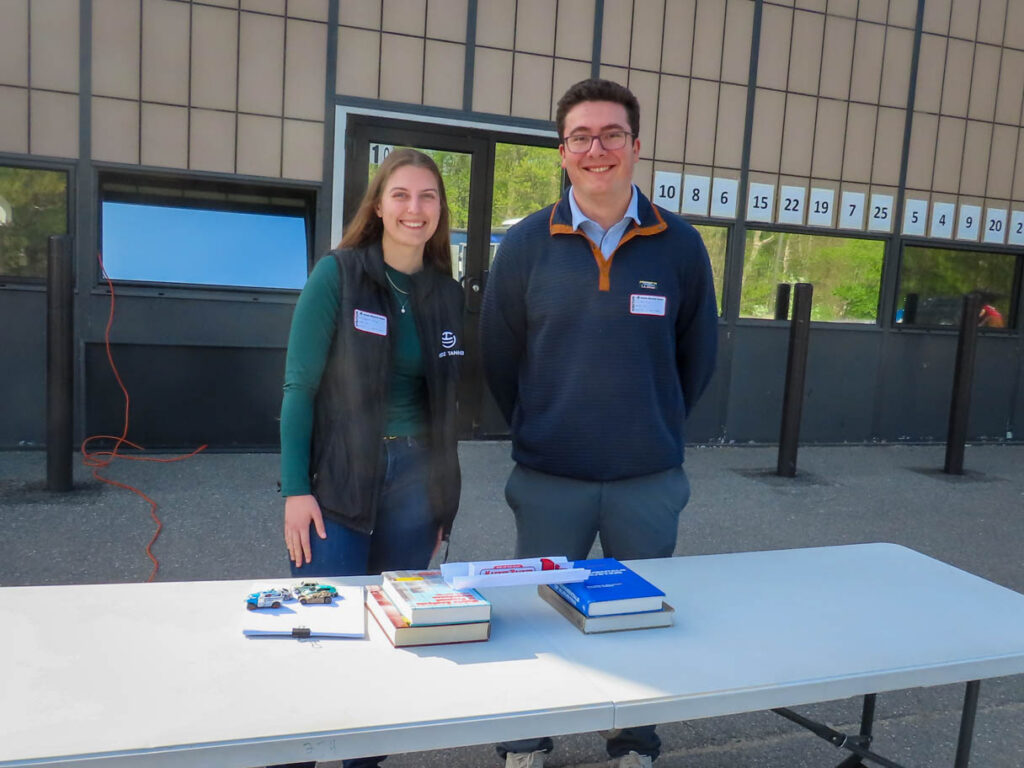
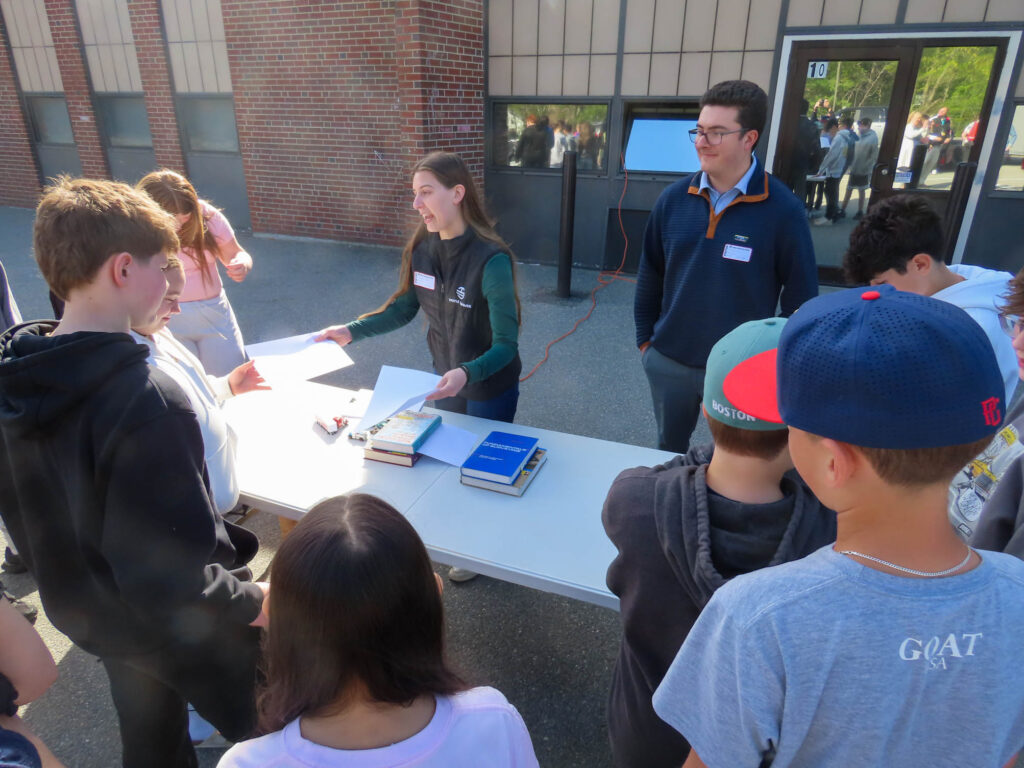
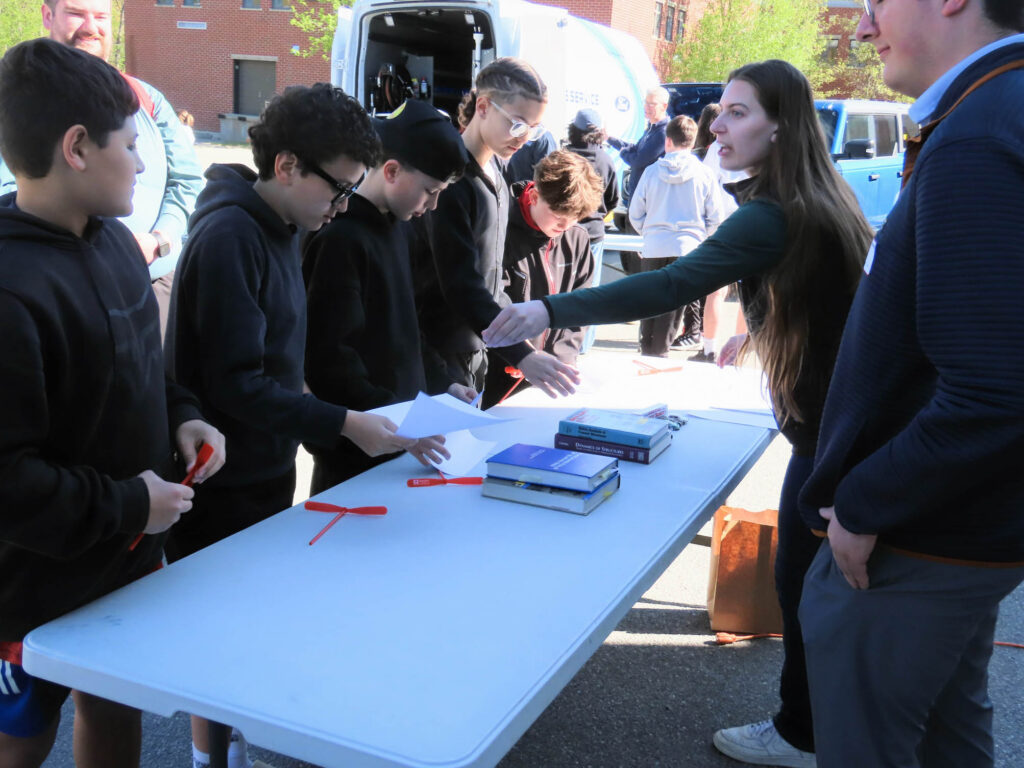
Hudson Memorial School recently hosted me and my colleague Steve Hansen for the 7th graders’ “Explore Your Future” STEM & Transportation Day. There we conducted a series of fast-paced, 5-minute sessions that provided students with a glimpse into the world of bridge engineering. We settled on paper bridges to be quick, simple, and have instant impact. Each student was given a sheet of paper and directed to manipulate the sheet to span a certain distance and hold a certain weight. The goal is to experience how different folding patterns achieve different results.

One of the most rewarding parts of volunteering to educate students as an engineer, besides encouraging the innate curiosity of young people, is successfully distilling complex concepts into simple demonstrations where it can ‘click’ with the audience. While bridge design mechanics are not completely foreign to me anymore, watching students intentionally explore structural behavior emphasizes the difference between seeing something happen in front of you and understanding how it works.
A gust of wind, a half-baked solution, and a different vehicle loading pattern were simple moments I observed at Hudson Memorial that demonstrated the natural forces that engineers design for every day. And, for my benefit, served as practical reminders of why we check wind loads, construction conditions, and vehicle loading configurations in our everyday work.
Wind Comes in Many Shapes & Sizes
We were outside for this volunteering event, and it happened to be a windy, and especially crisp spring morning. One of the groups was loading a matchbox car onto their bridge when suddenly a massive gust of wind swept the car right off! A couple students screamed, most laughed, and I thought about the serious implications of wind.
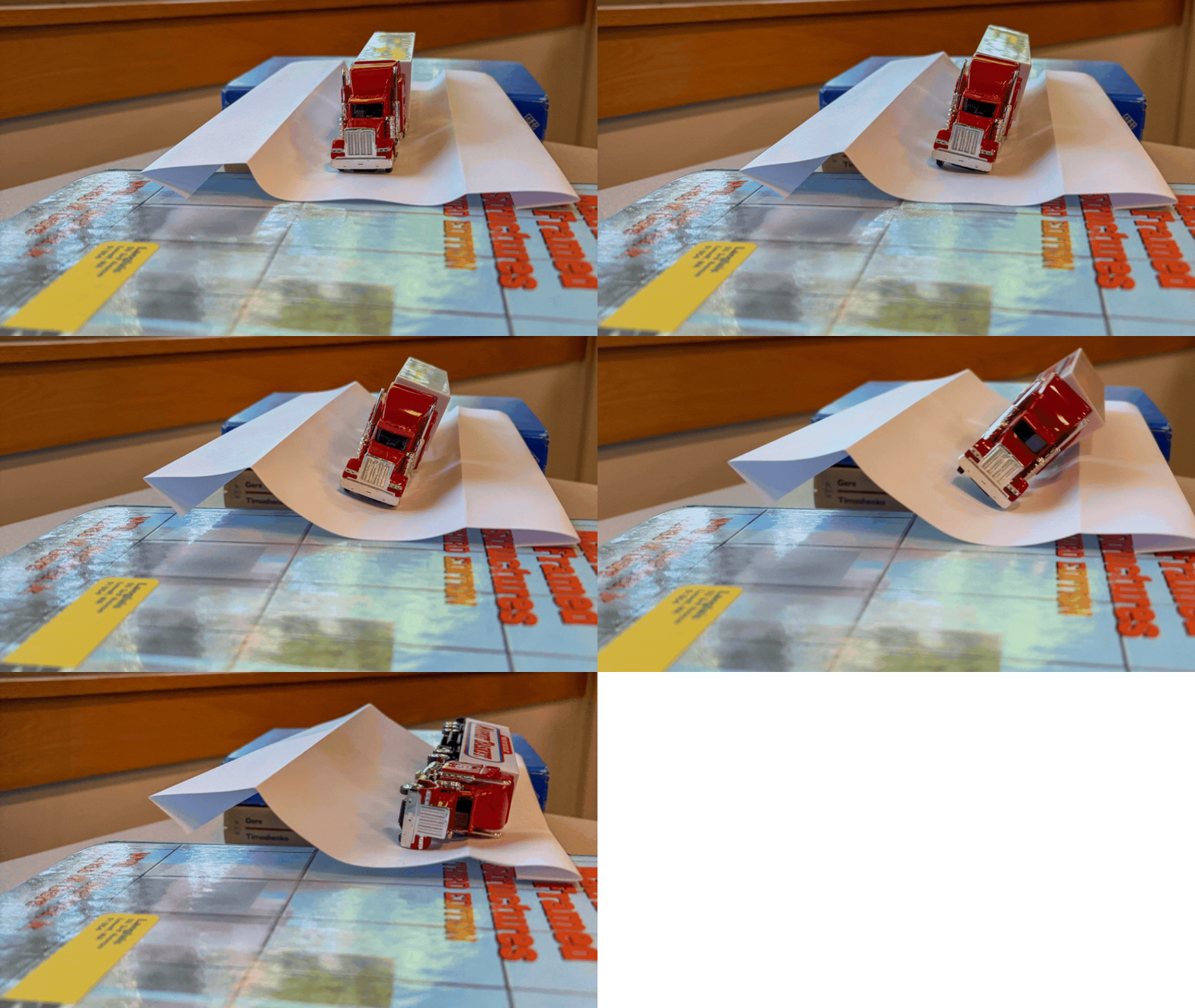
I shared with them the importance of wind load not only on the superstructure, or substructure, but on the vehicles traveling along the bridge. When wind is being applied to the side of a vehicle, it produces an overturning effect that is carried into the substructure, specifically for piles. In this case, we didn’t have a substructure or even bearings that could ‘pin’ the superstructure down. Because of this, the gust of wind we experienced that day caused the paper bridge to overturn as well, which showcased the effects of vertical wind load on superstructures.
Seeing a bridge deck, and the cars on it, getting completely overturned from a gust of wind is fortunately not something I have experienced in real life. Although I perform those calculations regularly, this served as a clear reminder of why wind loads are included in design. And as a practical takeaway for the traveling public, if it’s especially windy and you happen to be driving along a bridge with whipping winds, be cautious near taller vehicles like tractor trailer trucks because they are more susceptible to overturning!
Construction Safety & Stability are Non-Negotiable
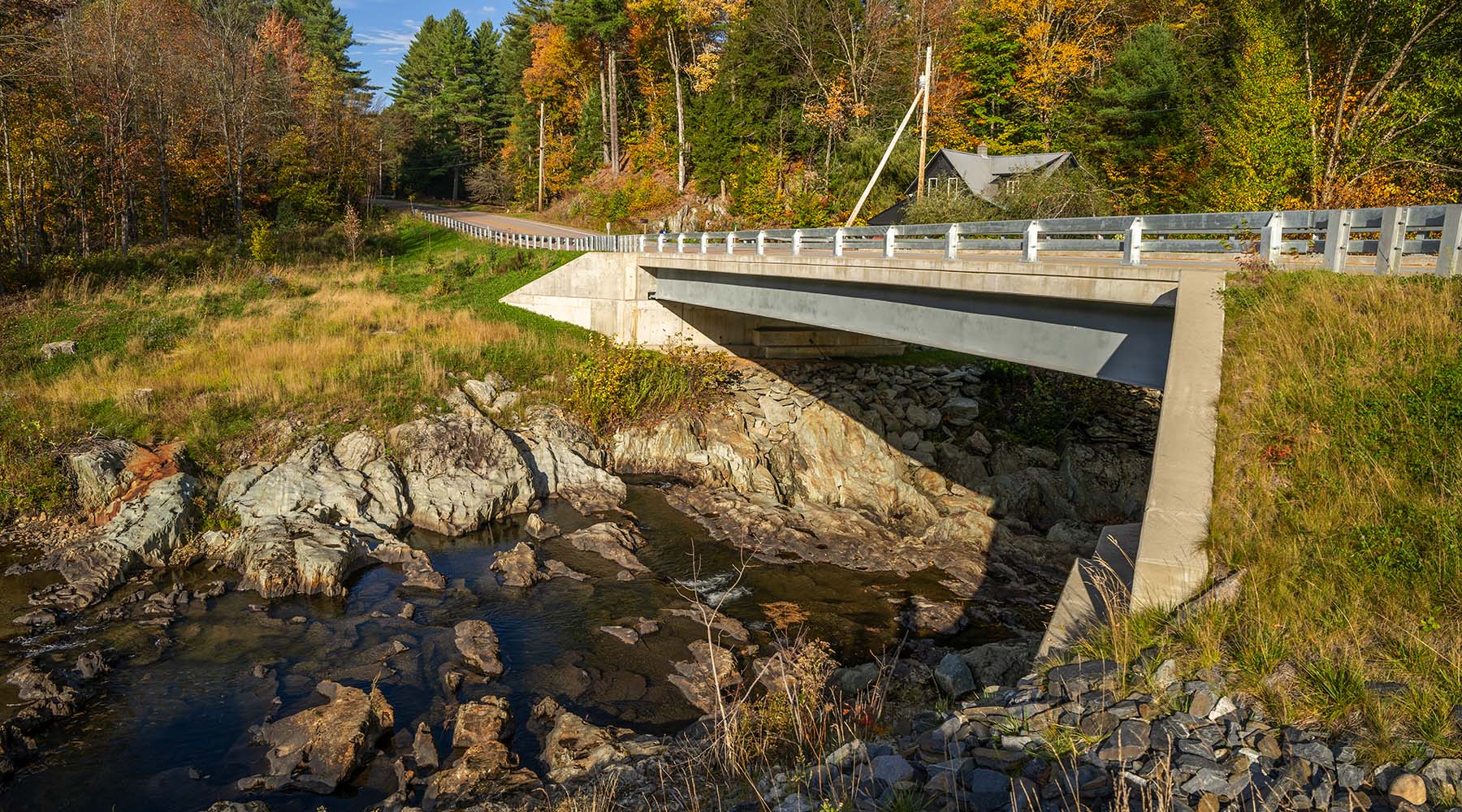
One student took their sheet of paper and, without folding it at all, loaded a car onto it. Obviously, it fell. The paper on its own cannot support that weight without some manipulation. The same applies to bridges during construction. The structure is most vulnerable before the critical structural components are set in place and yet the same natural forces are bound to act on it such as wind, hurricanes, and flash floods.
When we check our design for the construction stages, we think about the difference in dead and live load, how they’re distributed, and how to keep the structure stable for crews to work on safely. Instead of thinking about a vehicle crossing the bridge, we focus on the eccentric loads from brackets carrying walkways and safety rail, and a screed machine finishing the wet concrete deck along the span. We break down the construction sequence to check that the bridge can be built throughout different stages, and what measures need to be in place so both temporary and final conditions are accounted for.
Although most people only notice the finished product, engineers analyze every stage of a project all the way from breaking ground to ribbon cutting. The constructability checks done in the office translate to protecting the structure and the crews until the bridge is open to the public.
Not All Vehicle Loading is Created Equal & That’s The Point!
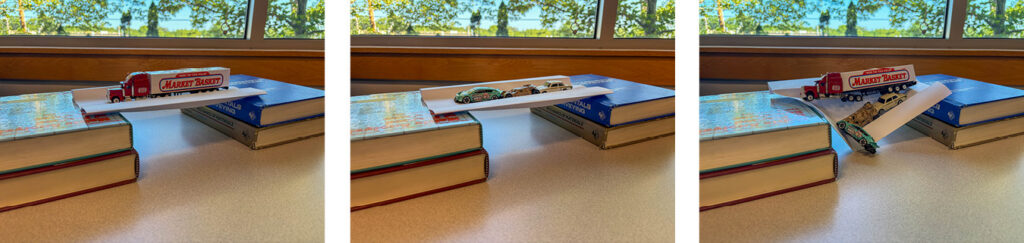
In one group, we had the students load their bridges with all the matchbox cars first. Multiple attempts, multiple failures. In another group, we decided to mix it up and load the bridge with the big truck first. Can you imagine what happened? The truck barely made a dent in the paper, even after we loaded all the other matchbox cars on top with it!
This concept of vehicle loading combinations is something most people might not realize, and the students were a little surprised, too. Because the paper was along such a short span, the shorter cars produced the more severe response (failure). This directly translates into the calculations I perform often. Small spans are usually more sensitive to vehicles with tighter axle spacing because they apply a higher concentration of load to the superstructure. With a wider axle vehicle, the load is less concentrated. Design for vehicle loading has evolved throughout time as modern practices change. It’s an interesting subject that STRUCTURE Magazine had a great article on if you’re interested in learning more.
Watching participants experiment with vehicle placement reminded me that engineering is often about finding the critical condition which may not necessarily be the obvious one. The most important scenario isn’t always the one that looks the most dramatic.
Engineering Lessons are Everywhere
For me, one of the most rewarding aspects of volunteering is seeing students connect what they were experiencing to the broader world around them. Engineering can sometimes feel abstract when discussed in a classroom or textbook but when students can see those concepts in action (and even test them themselves) the lessons become more meaningful.
Events like this are a reminder that engineering concepts are all around us. A gust of wind, a line of matchbox cars, and a paper bridge on a folding table demonstrate many of the same principles that influence the design of critical infrastructure.