Demand for aircraft hangars is outpacing availability at many airports. According to the Aircraft Owners and Pilots Association (AOPA), 71 percent of airports across the country have reported a shortage of General Aviation (GA) hangars, with many waitlists spanning several years. Most airports have available land to develop, but often lack the financial resources or planning needed to accommodate interested developers. Successful hangar development begins well before the interested party shows up at the airport; it is done through thoughtful planning efforts by airport management. At Hoyle Tanner, we help airports throughout New England and Florida navigate from conceptual hangar planning to design and construction. We have identified four key areas that should be considered when developing hangars.
Do You Know Your Market?
Aircraft hangars come in various shapes and sizes, primarily driven by the needs of the prospective tenants. The three most common styles of hangars are T-Hangars, box, and corporate hangars. T-Hangars are small, individual hangars that are ‘T’-shaped and accommodate one GA aircraft. T-Hangars can be in a standalone building or a larger building in a nested configuration. Box hangars are rectangular and can house multiple aircraft depending on the size. Aircraft hangars come in different shapes and sizes depending on the aircraft and tenants they serve. Smaller T-Hangars typically accommodate individual general aviation aircraft, while box hangars can accommodate multiple aircraft. Larger corporate hangars are designed for jet aircraft and may also include office space. There is no one-size-fits-all approach to hangar development.
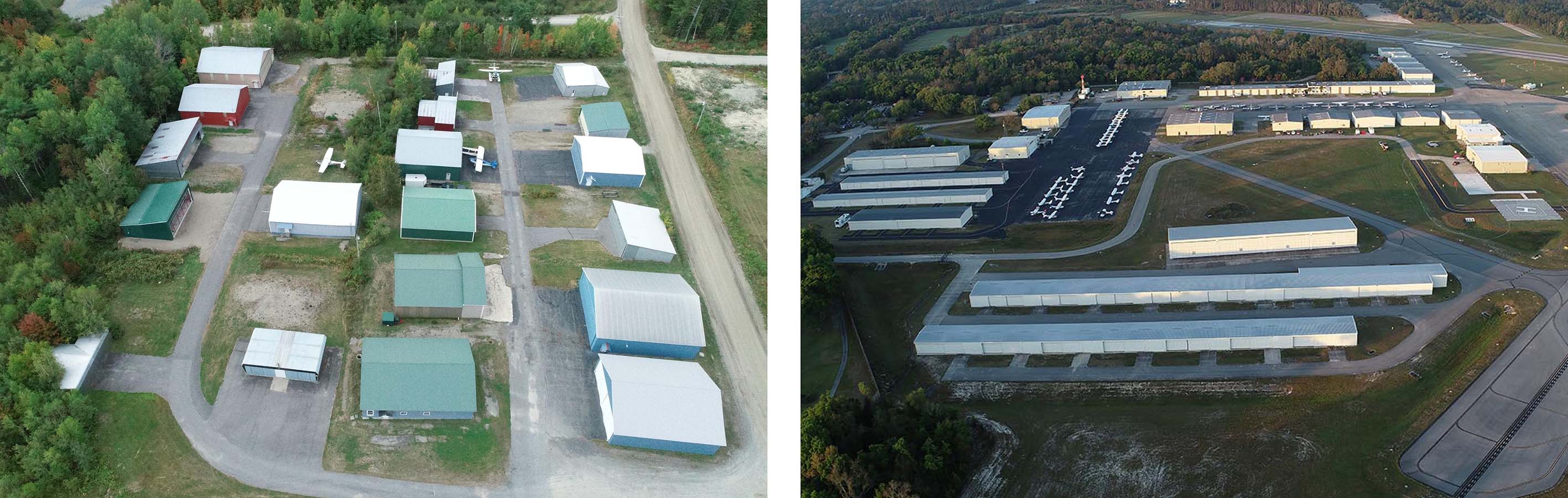
Hangar needs vary by airport and there is no universal standard for which type or size of hangar should be built. The right type of hangar depends on where an airport is located and the aircraft and customers it serves. A busy airport serving a large metropolitan area, such as Teterboro Airport (TEB), may favor the development of corporate hangars, while a smaller GA airport, such as Lake Wales Municipal Airport (X07), will develop more T-Hangars and box hangars. Airport managers need to know the market they serve and the size of hangars desired. Understanding the hangar demand allows for better planning of space and resources towards the new development.
Most recently, the Millinocket Municipal Airport (MLT) in Millinocket, Maine, was able to identify its current and prospective needs when developing a new taxilane for hangar development. Although MLT is a small GA airport in Maine, they understood that the pilots at the airport prefer box hangars over T-Hangars. Our team began planning for the new taxilane and hangars during the 2023 Airport Master Plan Update and oversaw the taxilane construction this summer.

Where Should the Hangars Be Located?
One of the most important factors when selecting a hangar location is the proximity to critical infrastructure. One of the most important factors when selecting a hangar location is the proximity to critical infrastructure. Tenants want be located close to areas such as the terminal building and fuel farm. Less taxiing from hangars equals more time and fuel saved for pilots.
Utilities are another important consideration. Hangars typically need electricity and plumbing, so developing near existing utility connections can reduce the amount of new infrastructure needed and help control development costs.
Although there is no universal standard for spacing between hangars, adjoining units can share a wall if the buildings meet applicable fire protection standards. When hangars are separated, the spacing should provide sufficient clearance for snow to shed safely from the roofs.

In colder climates, even the direction a hangar faces can make a difference. Hangars with south-facing doors and away from the prevailing winds are preferred since this limits snow and ice accumulation during the winter. Tenants are often responsible for snow removal in front of hangar doors, which heightens the importance of the building orientation to the owners.
Once the preferred hangar site is selected, the airport should update its Airport Layout Plan (ALP) as a pen-and-ink update. The Federal Aviation Administration (FAA) will conduct a review of the updated ALP to ensure the proposed hangars do not impact any other planned developments. Since it is a grant assurance for federally obligated airports to have an up-to-date ALP, completing a pen-and-ink early in the process will ensure sufficient time is allowed for review. Additionally, all proposed construction on the airfield must be coordinated through an FAA Form 7460-1, Notice of Proposed Construction or Alteration, for airspace approval. A 7460 form must be submitted at least 45 days prior to construction, with the review period spanning up to 90 days. Coordinating documents for FAA review early in the process ensures there is an appropriate amount of time to revise the plans should any issues arise.
Which Ownership Model Is Right for Your Airport?
Who owns the hangars affects how they are funded, managed, and leased. Airports generally have several options to consider:
- Airport-owned – The airport constructs and owns the hangars and leases them to individual tenants. This gives the airport greater control over the buildings.
- Privately owned/developed – A private developer funds and constructs the hangar, while the airport generates revenue through a land lease. Airports generate revenue through a land lease, often for a 40-year term. Owners and tenants would abide by any airport protocols outlined in the land lease, as well as minimum standards.
- Condo Association – A private developer constructs the hangars, which are then leased to individual occupants. A condominium association or property management company oversees shared maintenance, including repairs, landscaping, and snow removal. The association may hold a ground lease with the airport. An example of a Condo Association owner would be a Fixed Base Operator (FBO), with a land lease from the airport.
Regardless of the ownership model, clear development standards can help airports establish expectations for building size and placement, parking, permitted uses, and ongoing maintenance.
How Will You Fund the Project and Prepare for Developers?
Funding will remain the largest hurdle for hangar development. Airports can receive federal funding for airport-owned hangars through the Airport Improvement Program (AIP); however, hangar projects do not compete well for discretionary funds. Airports can also utilize state or local funding to construct hangars. Additionally, public-private partnerships present the opportunity to minimize the local funds used for hangars. The ownership model, anticipated lease revenue, utility and site-development costs, and ability to phase construction should all be evaluated to identify a financially feasible approach.
Airports can attract hangar developers by completing site preparation in advance, reducing the time, cost, and uncertainty associated with construction. For hangars planned on an undeveloped site, permitting, drainage improvements, grading, surveying, and utility extensions may be incorporated into a related project, such as a taxilane designed to support future hangar development. At Lincoln Regional Airport (LRG) in Lincoln, Maine, our team is currently designing an AIP-funded taxilane project that includes surveying, grading, permitting, and utility preparation for up to six new box hangars. Airports should coordinate with their local FAA office early in the planning process to confirm the eligibility of these project elements.
Plan Now for Successful Hangar Development
Successful hangar development starts with understanding an airport’s needs and preparing for future development early. By considering hangar demand, location, ownership, funding, utilities, and site preparation before construction begins, airports can create a clearer path for development to move forward. Early planning can also help reduce the time, cost, and uncertainty associated with future hangar construction.
If you have questions about funding or hangar development, please contact, Schuyler Lamoureux to learn more about how Hoyle Tanner can assist with the process.