For transportation agencies, successful project delivery extends well beyond developing plans and specifications.

The most challenging risks often emerge after a project moves beyond concept development. Drainage conditions evolve. Utility conflicts surface. Environmental considerations require refinement. Contractors propose alternative approaches. Construction teams need answers quickly to maintain progress.
The challenge is no longer limited to developing a technically sound design. Agencies must also manage risk, maintain momentum, and support implementation through construction.
The reconstruction and rehabilitation of US Route 1 in Van Buren, Maine offers a useful example of how coordination, flexibility, and continued technical support can help transportation projects navigate complexity across every stage of delivery. The project involved approximately 2.75 miles of a Priority 1 Corridor on the National Highway System and progressed through multiple MaineDOT milestone phases before advancing into construction support services. While the technical improvements were significant, the project also illustrates how successful transportation delivery depends on managing risk, coordination, and decision-making throughout the entire project life cycle.
Building Success Into Every Project Phase
Project success depends on balancing a wide range of competing priorities:
- Achieving design standards with variances or exceptions documentation
- Maintaining schedule commitments
- Managing public expectations
- Coordinating with utilities & railroads
- Navigating environmental & permitting requirements
- Minimizing impacts to adjacent properties
- Delivering lasting, constructible solutions
As projects increase in scale and complexity, those considerations become increasingly interconnected.
In Van Buren, the project included roadway reconstruction through the Keegan Village area, rehabilitation beyond the village limits, drainage improvements, culvert replacements, sidewalk improvements, environmental coordination, Right-of-Way activities, and ultimately construction-phase engineering support. Addressing those interconnected considerations required more than technical solutions alone. It required a structured process that allowed issues to be identified, evaluated, and resolved as the project evolved.
Building a Foundation Through Incremental Project Development
One of the most effective ways to manage risk on complex transportation projects is through a structured milestone-based development process.

For the Route 1 Reconstruction, development progressed through multiple milestone stages, including Horizontal Vertical Alignment Complete (HVAC), Preliminary Design Report (PDR), Plan Impacts Complete (PIC), Plans, Specifications & Estimate (PS&E), and construction-phase engineering services.
Each milestone served as a decision point to identify and resolve issues before they affected schedule, budget, or construction operations.
Managing Technical Complexity Across a Corridor
The Van Buren project demonstrates how transportation improvements often require balancing a variety of technical considerations all along a single corridor.
Within the Keegan Village segment, reconstruction efforts were highly restricted by adjacent and opposing structures to set finished horizontal and vertical roadway alignments proposing improvement including raised sidewalks, drainage infrastructure to alleviate demonstrated flooding issues, parking accommodations, and streetscape considerations.
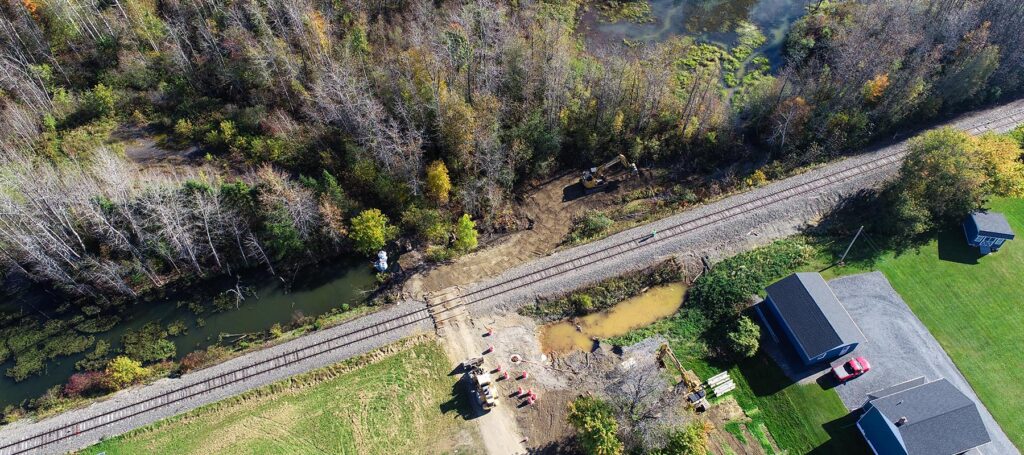
Outside the village, roadway rehabilitation design emphasized preservation of existing roadway materials and long term pavement structure performance while proposing shoulder widening improvements, new drainage structures, pipes and conveyances. In addition to hydrologic and hydraulic design parameters, multiple culvert replacements addressed habitat-related design considerations including fish passage and terrestrial species connectivity requirements. These designs are appropriately evaluated and advanced during each project phase for determination of culvert size and geometry, stream performance, scour protection, constructability, environmental and Right-of-Way impacts and cost.
These considerations illustrate how individual design decisions can influence project delivery, environmental commitments, constructability, and long-term performance across the corridor.
When Flexibility Becomes a Project Advantage
Large transportation projects rarely proceed exactly as anticipated.
New information becomes available, stakeholders contribute and construction conditions differ from assumptions. Alternative approaches are proposed. Agencies must balance innovation with reliability while maintaining project goals.
During construction, the team responded to RFIs, provided design clarifications, and participated in project meetings to resolve field conditions as they arose. Institutional knowledge remains available when decisions need to be made quickly. That continuity helps maintain project intent while supporting efficient project delivery.
For instance, revisiting the use of Horizontal Directional Drilling, working through drainage system revision in response to discovered underground utility pipe bedding materials previously placed and to make use of a found drainage outlet within the Keegan Village area.
These activities illustrate how project teams can adapt to changing conditions while maintaining project objectives.
When agencies and project teams can evaluate alternatives efficiently, respond to field conditions quickly, and provide technical clarity during construction, they reduce the likelihood that small challenges become major delays or escalate cost.
Coordination Remains One of the Most Effective Risk Management Tools

Transportation projects frequently involve multiple stakeholders, disciplines, and regulatory considerations. Throughout development, the Van Buren project required coordination related to drainage, environmental review, geotechnical services, utilities, railroad interests, public involvement, Right-of-Way acquisition, permitting requirements, and construction activities.
While these tasks may seem independent, they are often deeply connected: A drainage decision may affect permitting. A utility conflict may influence construction sequencing. A Right-of-Way consideration may affect design limits. Public feedback may influence implementation strategies.
For project owners responsible for delivering infrastructure improvements, early and ongoing coordination remains one of the most effective tools available for reducing uncertainty and maintaining project progress.
A Project Delivery Mindset
The Van Buren US Route 1 Reconstruction and Rehabilitation project demonstrates an important principle for people managing infrastructure upgrades: Successful project delivery is not defined by a single milestone.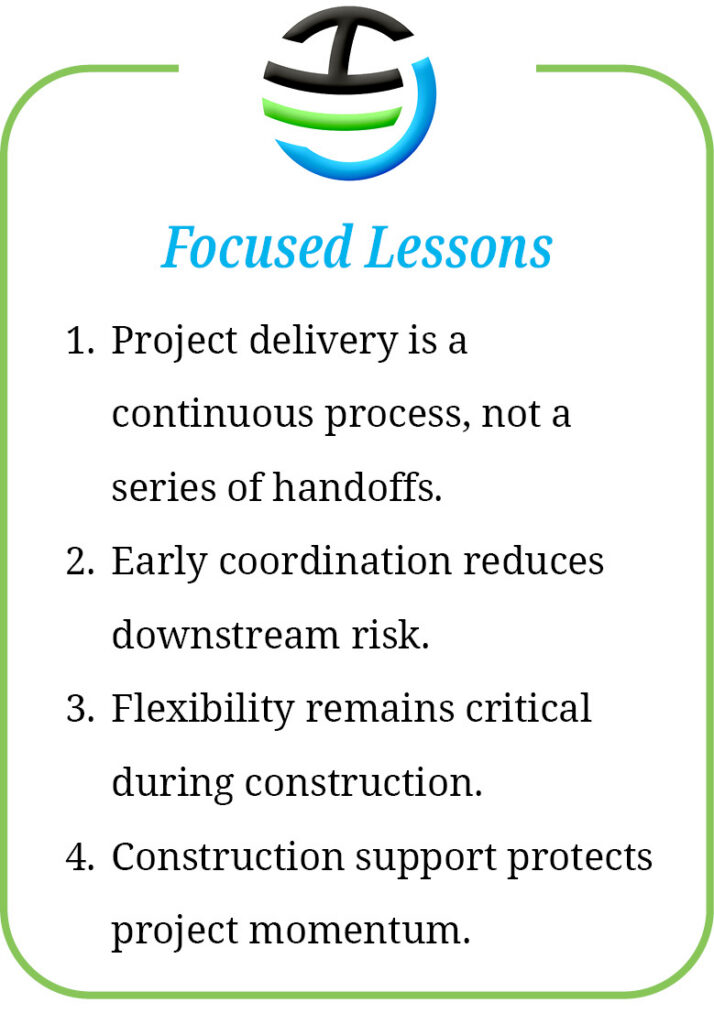
It is the result of consistent coordination, disciplined project development, responsiveness during construction, and a willingness to adapt as new information becomes available.
From preliminary design through construction support, the project required collaboration across multiple disciplines and stakeholders while continuing to advance toward implementation. The project ultimately received an Excellent consultant evaluation from MaineDOT, including positive ratings related to scope, quality, schedule, and communication.
As transportation agencies continue to address aging infrastructure, evolving regulations, and growing demands on public resources, successful delivery will increasingly depend on integrating planning, design, and construction into a coordinated project delivery process. The Van Buren Route 1 Reconstruction project demonstrates how continuity, collaboration, and responsiveness can help agencies move complex projects from concept through construction.