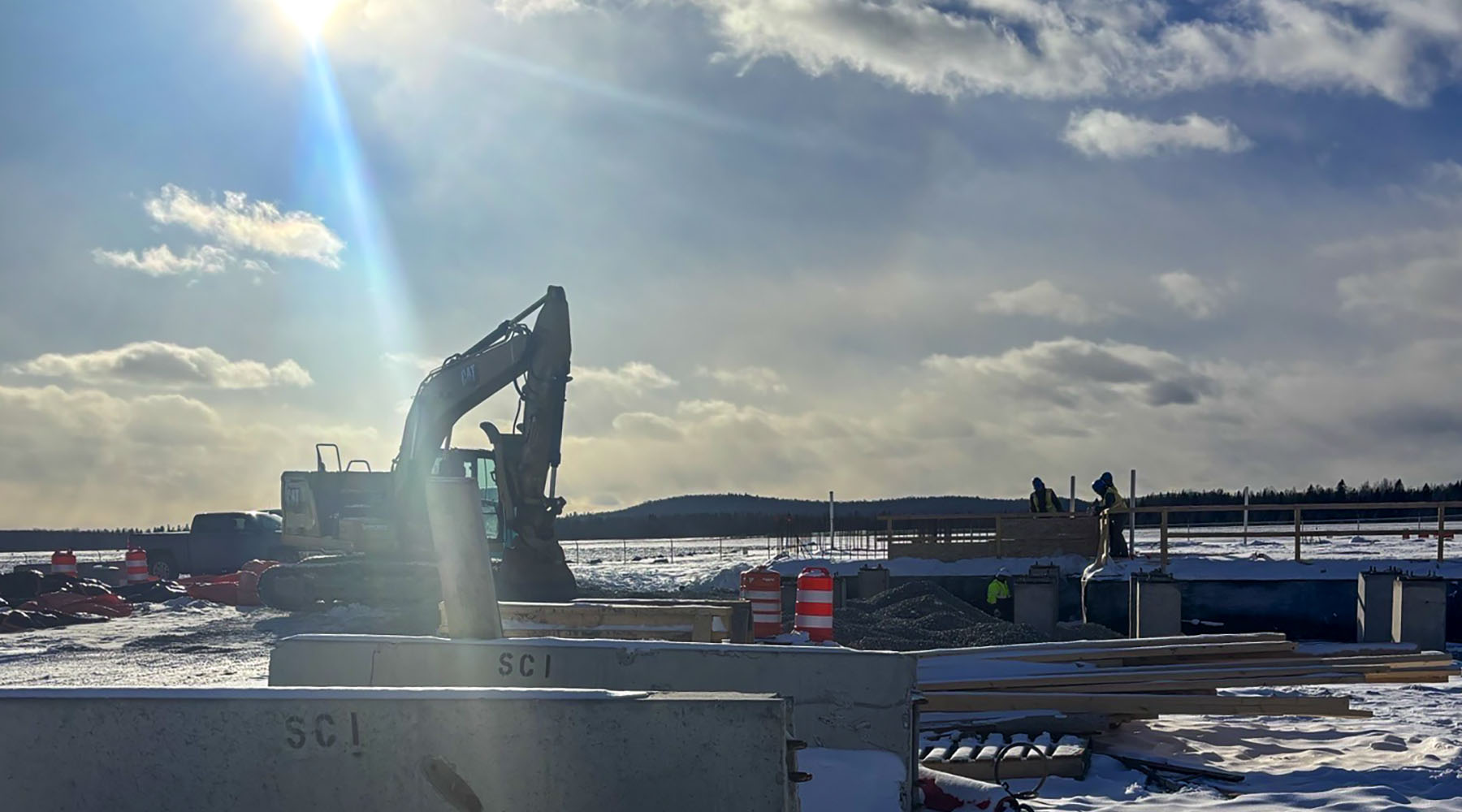
The intent of this multiphase project was to restore the pavement quality of both runways and improve the Runway Safety Area (RSA) for primary Runway 4-22 at Auburn-Lewiston Airport. Following a pavement evaluation, it was determined that the pavement on the crosswind Runway 17-35 needed full reconstruction and Runway 4-22 pavement would require rehabilitation including a mill, overlay and grooving. As part of the reconstruction of Runway 17-35, Taxiway B also needed to be reconstructed to conform to the new FAA Advisory Circular geometric standards. Hoyle Tanner prepared the required stormwater and Site Location of Development permit with MaineDEP.
This project also addressed the RSA for Runway 4-22 which was not in compliance with FAA standards. These RSA improvements were originally proposed as part of the recommended alternative in a previous NEPA Environmental Assessment (EA). Hoyle Tanner prepared the Categorical Exclusion (CatEx) documentation and secured a Finding of No Significant Impact (FONSI) from FAA.
SERVICES
Design
Permitting
NEPA Documentation Process
Bid Process Administration
Construction Administration
Construction Observation
Grant Administration
From the blog
Learn about ongoing projects and the innovative processes we employ for our clients.
We are excited to welcome Dana Martin, PE to Hoyle Tanner as a Project Manager in our New England Municipal Engineering Division! Dana brings nearly 15 years of experience...
Meet Travis Gelinas - CADD Designer & Creative Craftsman What drew you to Hoyle Tanner? I previously worked for a company that supplied vending services to Hoyle Tanner and...
This work represents an important step in improving airfield operations and long-term efficiency at the airport. Our team is providing design and permitting services for new pavement, lighting, and...
Protecting federally listed bat species such as the Indiana bat (Myotis sodalis; IBAT) and Northern Long‑eared bat (Myotis septentrionalis; NLEB), has become an essential part of infrastructure planning and...
For communities along Lake Champlain, phosphorus reduction is not abstract policy — it is an ongoing operational responsibility. MS4 permit requirements, public expectations, and watershed protection goals all converge...
In northern climates, winter is more than a season – it's a construction variable. For airport projects in particular, cold-weather conditions can shape schedules, budgets, and even the quality...
Key Takeaways from The Wildlife Society’s Recent Webinar The Wildlife Society recently hosted a national webinar (led by Dr. Patricia Cramer) focused on the growing importance of wildlife connectivity...
Insights from the People Who Support Your Ground Transportation Infrastructure Every Day As we head deeper into 2026, we asked our ground transportation team one simple question: “What do...