Hoyle Tanner is currently providing wastewater engineering design services for the Town of Richmond, Vermont, to assess and develop alternatives which address the urgent need to upgrade the existing Bridge Street Pump Station (BSPS) due to its extreme vulnerability to flooding. The BSPS accepts wastewater flows from the southern portion of Richmond’s built community and conveys these flows over the Winooski River via an aerially supported force main pipeline. Both the pump station and the force main are below the FEMA 100-year floodplain, and as a result have been subjected to flood damage during multiple, federally declared major flooding events over 2023 and 2024.

Project Context & Existing Conditions
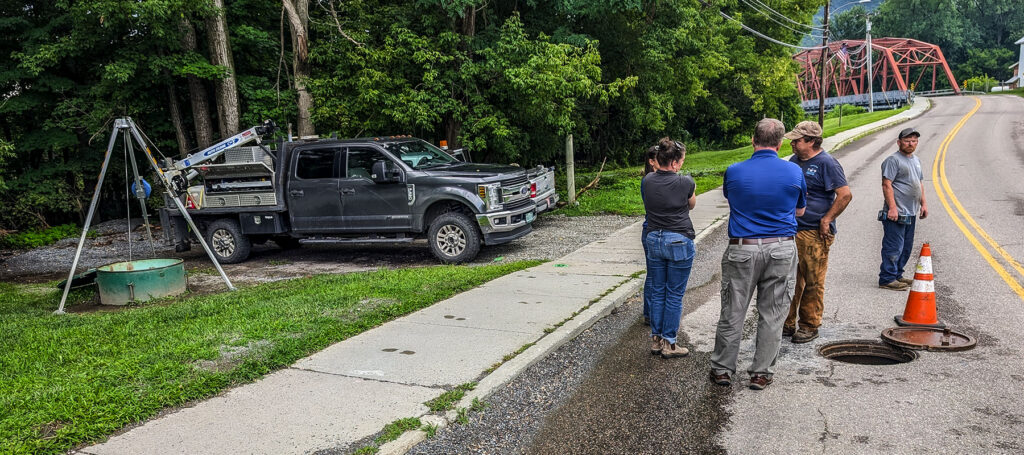
The BSPS is a critical component of the Town’s wastewater system, conveying flows to the Richmond Wastewater Treatment Facility (WWTF). However, the station is situated within the Federal Emergency Management Agency’s (FEMA) 100-year (Zone AE) floodplain, just 350 feet from the Winooski River. This location has resulted in repeated catastrophic flood damage, including the events in 2023 and 2024, which required emergency actions to restore wastewater services. The station’s wet well sits at an elevation of 305 feet above mean sea level (MSL), which is significantly below the 100-year Base Flood Elevation (BFE) of 310.3 feet and the 500-year flood level of 313.9 feet, rendering the facility inaccessible and potentially inoperable during floods.
Additionally, the facility and the equipment within are well past their design lifespans, having served the Town in its current location since 1972. The station employs a non-conventional pneumatic ejector system, which utilizes air compressors to force wastewater through the system, rather than modern, rotating impeller pumps. The pump station also lacks modern system capabilities such as SCADA connectivity and flow data recording.

Need & Future Capacity
The project is crucial in order to maintain public health and sanitation and prevent any discharge of raw wastewater into the Winooski River, a Class B (2) water and Cold Water Fish Habitat. The upgrade is necessary to bring the facilities into compliance with state flood protection standards. Future flow projections for the next 20-year design cycle—factoring in a planned developments and potential buildout—were performed to allow the upgraded pump station to remain useful for many years to come.
Alternatives Analysis
To date, Hoyle Tanner has analyzed three potential pump station upgrades for Richmond, considering relocation to different locations. The Town has heard feedback from its residents and is considering a fourth, new, location as well. Each location presents its own challenges between existing grade elevations, tightly-constrained available space for construction, and proximity to the Round Church—a registered National Historic Landmark and treasured element of the Town’s identity. Hoyle Tanner is working closely with the Town of Richmond, the Richmond Historical Society, and Vermont Department of Environmental Conservation to develop a preferred upgrade design.
Hoyle Tanner’s Municipal Engineering Division routinely works to identify solutions in the areas of wastewater conveyance and disposal, climate resilience and flood risk mitigation, public outreach, and assisting with State and Federal funding applications. Does your community need a trusted expert engineering partner? Reach out to me to talk about opportunities in your municipality!