
Emergency preparedness is one of the most important needs for any airport. While typically, an emergency is the “worst day” at an airport, how a response is implemented and managed makes all the difference. The emergency or event should remain the primary focus, and the airport’s response should demonstrate how well stakeholders understand their roles and responsibilities. This preparation positions the airport for a safe, effective, and efficient response.
A More Realistic Exercise
Hoyle Tanner recently partnered with Augusta State Airport to facilitate a collaboration-based emergency preparedness tabletop exercise where airport stakeholders can evaluate the emergency response plan, procedure and policy in a discussion-based hypothetical simulation. Augusta Airport Manager John Guimond reached out to Hoyle Tanner knowing he needed an experienced entity to act as an extension of his staff and support the airport by developing and facilitating this tabletop exercise. Every airport is unique, and Augusta is no exception, with Cape Air providing daily scheduled flights to Boston Logan International Airport and a robust mix of General Aviation activities. While the Augusta State Airport is not certificated by the Federal Aviation Administration (FAA) under Part 139, the airport does implement an Airport Security Plan under Transportation Security Administration (TSA) requirements. Thus, the airport is required to routinely conduct a tabletop exercise to ensure all stakeholders understand their roles and responsibilities in the case of an incident or emergency.
Typically, this consisted of a one-page document outlining a scenario developed by the airport staff, which served as the basis for an hour-long conversation amongst the stakeholders around a conference room table. Historically, participants included airport staff, airport tenants, local police and the local fire department. The Augusta Airport wanted something more robust, an exercise that would challenge the group and provide an opportunity for many new individuals within the stakeholder organizations to get involved and participate in a meaningful way. What was envisioned was an exercise that provided the opportunity for participants to think through an evolving scenario and lead to an extensive discussion.
Developing a Thorough Experience
Our team developed a realistic scenario to 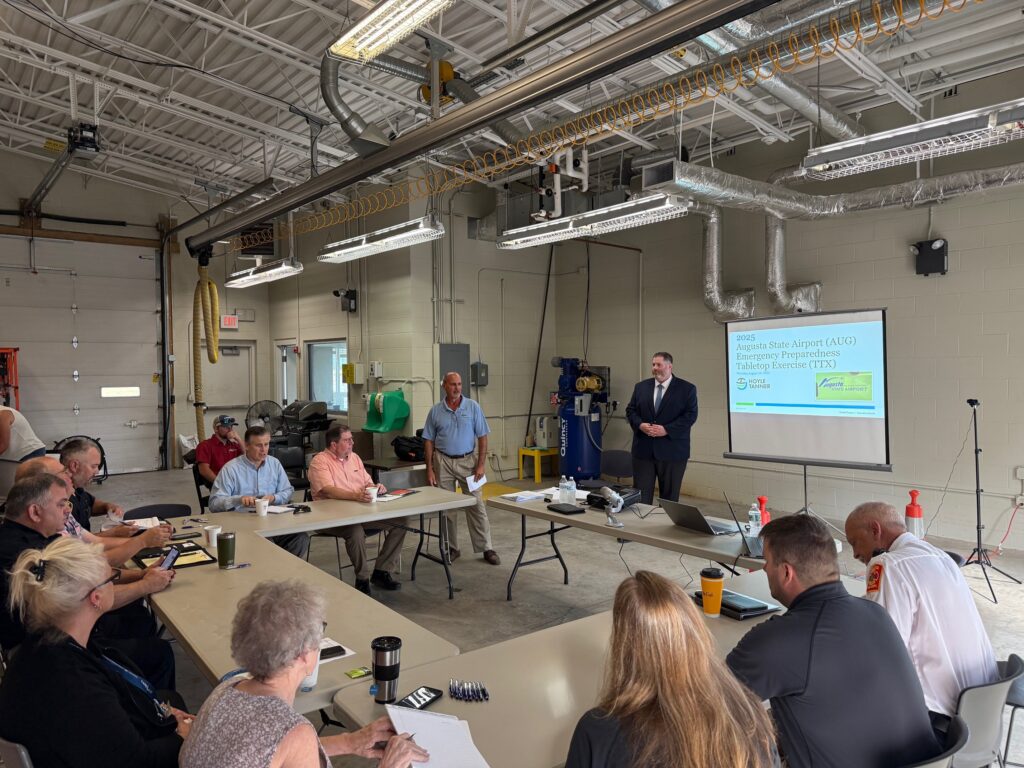
The Homeland Security Exercise and Evaluation Program (HSEEP) framework was utilized to ensure an effective exercise was planned. Within this framework, the scenario was developed featuring “injects” of action items for participants to progressively advance the scenario. This was documented in a presentation which was supplemented by a companion Situation Manual document developed by the Hoyle Tanner team, tailored to the scenario which served as a primer and outline for participants.
For this exercise, the scenario contemplated a twin-engine aircraft on approach to land suffering a wildlife strike with an engine-ingestion. This led to a runway excursion upon landing and resulted in a collision with a single engine training aircraft taxiing out for takeoff. Both of these aircraft types are common amongst the operations at Augusta. Similarly, wildlife strikes are a common threat to aviation, the most famous example being US Airways Flight 1549, known as the Miracle on the Hudson Flight.
The tabletop scenario was based on actual aviation incidents and accidents that have occurred over the past two years at airports within the United States. The presentation featured videos of these actual aviation incidents, complimented by airfield imagery from Augusta to provide an immersive experience illustrating the scenario. This ensured the exercise would offer a high level of realism and provide a unique experience for participants to work through a situation that could occur at the airport.
The scenario was then further developed as additional information was provided to participants that the wildlife ingestion had actually been a collision with an unauthorized drone, or Unmanned Aerial System (UAS). The tabletop progressed with further developments, including additional security considerations such as exceedingly persistent reporters attempting to gain access inside the airport fence line perimeter via various methods. Each of these developments furthered the discussion and ensured that all stakeholders were deeply involved with the exercise.
Growing Through Collaboration
On the morning of the exercise, representatives from the airport, tenant organizations, the City, the State, law enforcement agencies and fire personnel came together and worked through the scenario collaboratively. The morning-long dialog involved every participant from the most experienced to the newest team members. Acting in a facilitation role, Hoyle Tanner team members moved the discussion along and ensured everyone was a participant, not just an attendee. The conversation and collaboration reached across agencies and provided the participants with an opportunity to ask questions of others to fully understand how their actions impact the actions of others during a response.
Action items included in the presentation provided opportunities for all stakeholders to participate. For example, the airport maintenance staff were asked to provide a mock 9-1-1 call supposing they were on a tractor mowing the airfield and witnessed the accident occur. Similarly, the first responders were asked to walk through scene priority and asset tasking as it would be conducted upon arrival at the scene. FBO staff discussed their procedures for responding to individuals trying to gain access inside the airport fence through their facility.
The exercise concluded as the group had reached and demonstrated a high level of familiarity with the roles and responsibilities of their own agency and those of the other stakeholders likely to be involved in an emergency response at the airport. When participants were asked via survey if the exercise was well structured and organized, the average score was 4.85 out of 5. Similarly, when asked if the participants believed their agency was better prepared to deal successfully with the scenario that was exercised the group averaged a 4.69 rating. These ratings along with a summary of the exercise activities were memorialized in an After-Action Report, again based on HSEEP guidelines. This document will continue on as a living document for the airport, serving numerous purposes. The After-Action Report serves as documentation for regulatory agencies that the exercise was completed, a reference guide for future training and to serve as a basis for planning the next emergency preparedness exercise for the airport.
Our team works diligently to provide extension-of-staff services beyond airport engineering and “standard” planning for airports of all sizes across New England and Florida. Whether your airport is working to meet the regulatory requirements of FAA Part 139 and/or TSA Part 1540 or simply wants to conduct an exercise to ensure stakeholders understand their roles and responsibilities, we can provide a tailored solution for you. Our team has experience designing and facilitating tabletop exercises as well as FAA-compliant Full-Scale Exercises to meet the FAA Part 139 triennial exercise requirements. Contact me for more information or to discuss how we can assist your airport with stakeholder collaboration and emergency preparedness.